


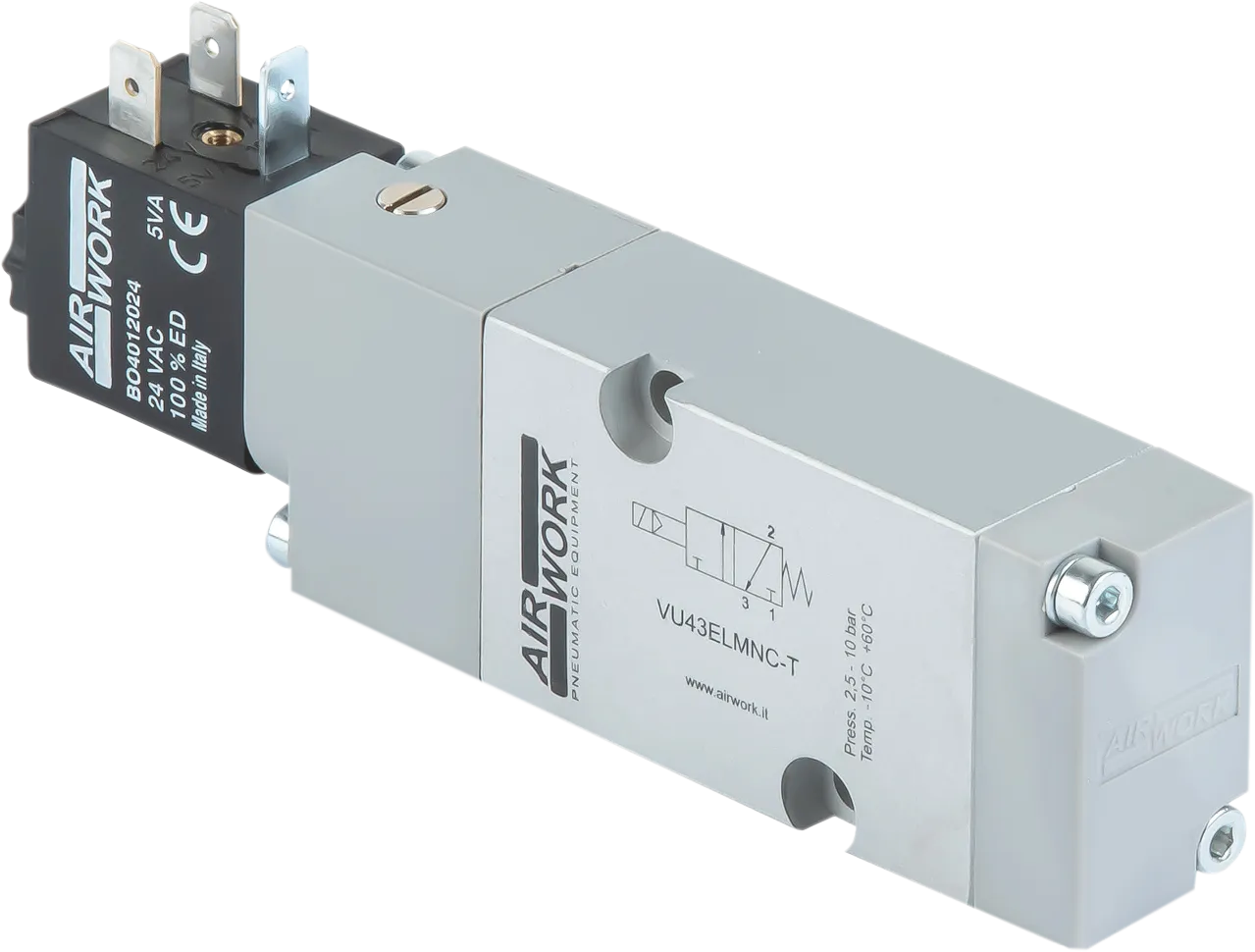
NAMUR Valves VU Series
Series VU pneumatic and solenoid valves with NAMUR interface are designed for direct mounting on rotary actuators and process automation cylinders. Eliminating the distance between the valve and the actuating element removes dead tubing volume, ensuring immediate response times, a drastic reduction in connections, and maximum reliability in heavy-duty operating cycles.
Key Highlights
-
Excellent Lifecycle: Guaranteed for over 50 million operating cycles.
-
Precision Mechanical Construction: CNC-machined aluminum body, anodized and painted for high resistance to corrosion and harsh environments.
-
Thermal Stability: Metal internal components to reduce thermal expansion and prevent jamming or seal leaks.
-
Flexible Control: Available with electric (solenoid) or pneumatic actuation.
-
Compactness and Modularity: 1/4″ NAMUR interface compliant with international standards in 3/2 and 5/2 functions.
Industrial Applications
-
Process Automation: Direct control of rotary actuators for industrial ball, butterfly, or segment valves.
-
Dosing and Mixing Systems: Rapid response times (on the order of milliseconds) essential for precision dosing.
-
High-Frequency Packaging and Handling: Long-term durability backed by a 50-million-cycle lifespan.
-
Harsh Environments: IP65 protection rating and protective anodization suitable for moisture, dust, and temperature fluctuations.
Additional Information
Application context: actuation of industrial valves
In process control systems, the actuation of a pneumatic valve follows three stages: signal → switching → movement. The second stage — the pneumatic control valve — is decisive for the response speed of the entire system and for the complexity of the installation.
When fast response times or frequent cycles are required, the pilot valve and its installation become critical to system performance. This is where the concept of NAMUR integration becomes a design choice, not merely a construction preference.
Limitations of Solenoid Valves with Remote Mounting
A solenoid valve mounted on a panel or centralized manifold, connected to the actuator through flexible tubing, introduces three systematic issues:
- Dead volume in the tubing: the air volume between the valve and the actuator must be pressurized or exhausted at every cycle. Even over short distances (0.5–1 m of 6–8 mm tubing), the additional volume slows the pressure front, extending the actual actuator switching time beyond the valve’s declared response time.
- Joints and fittings as leakage points: every threaded or push-in connection is a potential micro-leak point. In intensive cycles (>20 cycles/min), even minimal leaks result in cumulative pressure drops that reduce the available actuator torque.
- Maintenance complexity: identifying a fault in a distributed pneumatic circuit — with valve, tubing, and actuator separated — requires sequential inspections. Diagnosis and restoration time directly impact plant availability.
Principle of Direct NAMUR Integration
Actuator Mounting
The NAMUR standard (VDI/VDE 3845) defines a standardized mounting interface that enables the direct mounting of the valve onto the actuator, eliminating tubing between the two components. The VU Series valves implement this standard with 1/4 ports, compatible with the NAMUR dimensional class for medium- and large-size actuators.
The practical result is an integrated valve + actuator system: the supply pressure reaches the valve, which switches and directly feeds the actuator chambers through the internal ports of the NAMUR flange.
Reduction of Pneumatic Connections
In a remote configuration, a double-acting actuator with a 5/2 valve typically requires: 1 supply line, 2 working lines (→ chambers A and B), and 1 exhaust line.
With direct NAMUR mounting, the working lines are internal to the mounting flange — they disappear from the system topology.
Only the main supply and exhaust remain. This reduces connection components, potential leakage points, and pneumatic wiring.
The Design Advantages of NAMUR Valves
Compactness
The fully CNC-machined aluminum construction — anodized and painted — keeps weight low without compromising structural rigidity.
The absence of tubing between the valve and actuator eliminates the space occupied by fittings, a significant advantage in compact pneumatic panels or installations on actuators in difficult-to-access positions.
Response Speed
The response times declared by the manufacturer (Edition 2024) for pneumatic pilot operation are:
- Monostable: opening (TRA) 7 ms, return (TRR) 15 ms
- Bistable: opening and return 7 ms
With electrical pilot operation (solenoid):
- Monostable: TRA 19 ms, TRR 45 ms
- Bistable: TRA 22 ms, TRR 22 ms
These values refer only to valve switching. The advantage of NAMUR mounting is that the fluid path to the actuator is minimal: the pressure front reaches the actuator chambers almost instantaneously after switching, without penalties caused by tubing volume.
In high-frequency cycles, the difference in actual actuation time between a remote configuration and direct NAMUR mounting is measurable and significant.
Reliability
The guaranteed operating life of 50 million cycles is the relevant service-life parameter for long-term sizing. At 20 continuous cycles/min, 50 million cycles correspond to approximately 4,750 hours of actual operation before scheduled replacement.
The construction with internal metal components (instead of plastic) limits dimensional variations caused by thermal expansion, which in rapid cycles or environments with significant temperature fluctuations can compromise seal tightness.
The coil operates in continuous duty (ED 100%), with IP65 protection when mounted with connector. Power consumption is 3 W in DC (12 or 24 V) and 5 VA in AC (24, 110, 220 V), with an inrush current of 7.5 VA for AC versions: values compatible with most industrial PLC digital output modules without the need for intermediate relays.
Simplified Maintenance
The valve-actuator unit can be replaced as a single block. In the event of valve failure, only the NAMUR flange must be disassembled — four screws — without intervention on the tubing.
Replacement time is drastically reduced compared to a remote installation, which requires disconnecting tubes, fittings, and electrical wiring on separate components.
Impact on Plant Performance
On a process line with 20 pneumatic valves operating in repetitive cycles, replacing remote solenoid valves with direct NAMUR valves produces cumulative effects on three metrics:
- Reduction of air leaks: every eliminated joint reduces the risk of micro-leaks. In a plant with a 6-bar network, the energy cost of pneumatic leaks is often underestimated until an energy audit is performed.
- Reduction of pneumatic wiring: fewer tubes, fewer fittings, fewer fastening clips. During installation, this translates into saved labor hours; during operation, into fewer elements subject to mechanical deterioration from vibration or thermal cycling.
- Faster system response: in time-critical automation sequences (e.g. flow control reacting to process measurements), reducing actuation delay improves control quality and reduces overshooting.
Technical Analysis of VU Series NAMUR Valves
Construction Features
|
Parameter |
Value |
|
Nominal diameter |
7.5 mm |
|
Flow rate at 6 bar, ∆p 1 bar |
1,100 Nl/min |
|
Operating pressure (monostable) |
2.5 ÷ 10 bar |
|
Operating pressure (bistable) |
1 ÷ 10 bar |
|
Operating temperature |
−10 °C ÷ +60 °C |
|
Declared service life |
50 million cycles |
|
Body material |
Aluminum (CNC-machined, anodized, painted) |
|
DC coil consumption |
3 W (12 or 24 VDC) |
|
AC coil consumption |
5 VA operating / 7.5 VA inrush |
|
IP protection (with connector) |
IP65 |
The 1,100 Nl/min flow rate at 6 bar with ∆p of 1 bar is compatible with the direct supply of medium-size rotary actuators (for example the AT Series up to Ø32 mm), ensuring adequate chamber pressurization times even in rapid cycles.
Available Configurations
3/2 function (VU43): one working port, suitable for single-acting actuators with return spring. In NC (normally closed) configuration, the valve keeps the actuator in its rest position (extended spring) without electrical power — the preferred solution in safety applications where the fail-safe position is closed.
5/2 function (VU45): two working ports, for double-acting actuators. It allows independent control of the two actuator chambers, with full management of speed and torque in both directions.
Monostable vs. bistable: the monostable version returns to its rest position when de-energized (through spring or pilot pressure), ensuring deterministic behavior in the event of signal interruption. The bistable version maintains the last position even without power — suitable for systems where energy consumption must be minimized or where signal interruptions must not cause unwanted actuator movements.
Both versions are available with pneumatic (PN) or electrical (EL, solenoid) pilot operation.
Industrial Applications
VU Series NAMUR valves are designed for applications where fast response, operational reliability, and reduced pneumatic wiring are critical design requirements.
Their direct integration with pneumatic rotary actuators makes them particularly suitable for high-cycle industrial automation systems, where compactness and ease of maintenance directly affect plant performance.
- Ball valve and butterfly valve control: pairing with rotary actuators in direct NAMUR configuration is the primary use case.
- Dosing and mixing systems: short cycles (rapid opening/closing sequences) require response times measurable in tens of milliseconds.
- Process automation in harsh industrial environments: the anodized aluminum construction with IP65 protection and operating temperature up to +60 °C covers environments with dust, humidity, and thermal variations.
- Packaging and handling systems: the 50 million cycle service life is a determining factor in high-speed applications.
Selection Criteria: NAMUR Valves vs. Standard Solenoid Valves
|
Criterion |
NAMUR Valve (VU Series) |
Remote Solenoid Valve on Manifold |
|---|---|---|
|
System architecture |
Actuator with NAMUR flange |
Centralized manifold with tubing distribution |
|
Valve–actuator distance |
Zero (direct mounting) |
Variable (typically 0.3–2 m) |
|
Dead volume in the circuit |
Minimal |
Proportional to tubing length |
|
Actual response time |
Depends only on the valve |
Affected by tubing volume |
|
On-site maintenance |
Single-block replacement |
Intervention on separate components |
|
Number of pneumatic connections |
2 (supply + exhaust) |
4+ (supply + 2 work lines + exhaust) |
|
Typical application |
Industrial valves, rotary actuators |
Cylinders on centralized valve islands |
The NAMUR solution is recommended whenever fast response is critical and there is a need to reduce the complexity of pneumatic wiring.
VU Series NAMUR valves fulfill a precise role in pneumatic system architecture: eliminating the tubing connection between the control signal and the actuator, reducing the pneumatic circuit to its most direct form.
The application value is measured at system level: an actuator with a directly mounted NAMUR valve is a simpler, faster, and more maintainable unit than an equivalent remote configuration.


