


Quick coupling fittings PC Series
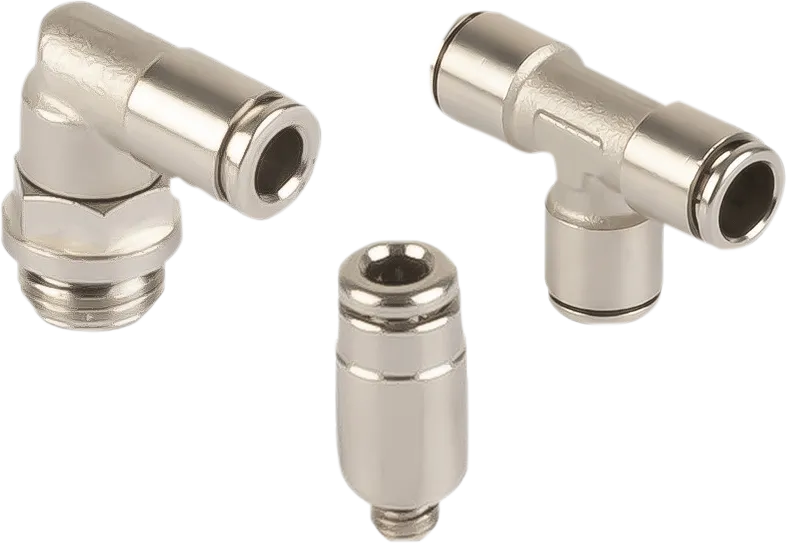
Push-in fittings are so defined as they allow to connect the tube to the fitting in a “instantaneous” way without using tools.
The tightness of the tube takes place through an elastic clamp which holds the tube on the external diameter and releases it by pushing the suitable puller.
This type of fittings is used in order to speed up the assembly phases mainly in reduced space and timesaving during connection of different pneumatic components.
 Perfect air tightness
 Can be used with any type of tube
 Safe coupling even on imperfect cuts
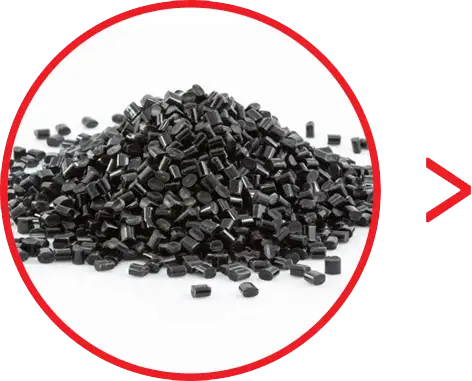 Made exclusively with virgin material
Further Information
The role of Push-In Fittings in Pneumatic Systems
In industrial pneumatic systems, every connection point between a tube and a component is a potential critical element: a non-uniform seal generates pressure losses that propagate throughout the entire network, increasing compressed air consumption and compromising the repeatability of operating cycles.
Push-in fittings eliminate variables related to manual tightening, making the connection immediate, repeatable, and independent of the operator’s skill. The result is a measurable reduction in assembly times and, during maintenance operations, the possibility of replacing a tube in just a few seconds without tools.
Operating principle and sealing performance
The locking mechanism is based on an internal elastic collet that contracts radially around the outer diameter of the tube when inserted. The collet geometry is designed so that axial traction — generated by fluid pressure or external stresses — enhances the grip rather than loosening it.
The pneumatic seal is provided by a lip seal positioned inside the fitting body: when the tube is correctly inserted, the seal compresses uniformly against its outer surface, preventing air leakage.
The tube is released by pressing the release ring, an element located at the fitting inlet that mechanically opens the collet. The operation requires no tools and does not damage either the fitting or the tube, making the connection fully reversible.
Construction features of the PC Series Push-In Fittings
The body of the PC Series fittings is made of high-strength engineered polymer, with a metal thread to ensure reliable tightening at the connection point to the pneumatic component.
This combination balances lightweight design and structural strength: the polymer material reduces fitting weight, facilitating installation in confined spaces, while the metal thread eliminates the risk of deformation caused by excessive tightening.
The lip seal maintains airtightness even when the tube is bent or not cut perfectly square: this reduces one of the most common causes of leaks in manually assembled systems, where tube cutting quality may vary from one operator to another.
The series is compatible with the main types of pneumatic tubing used in industrial automation.
Available configurations and their impact on system design
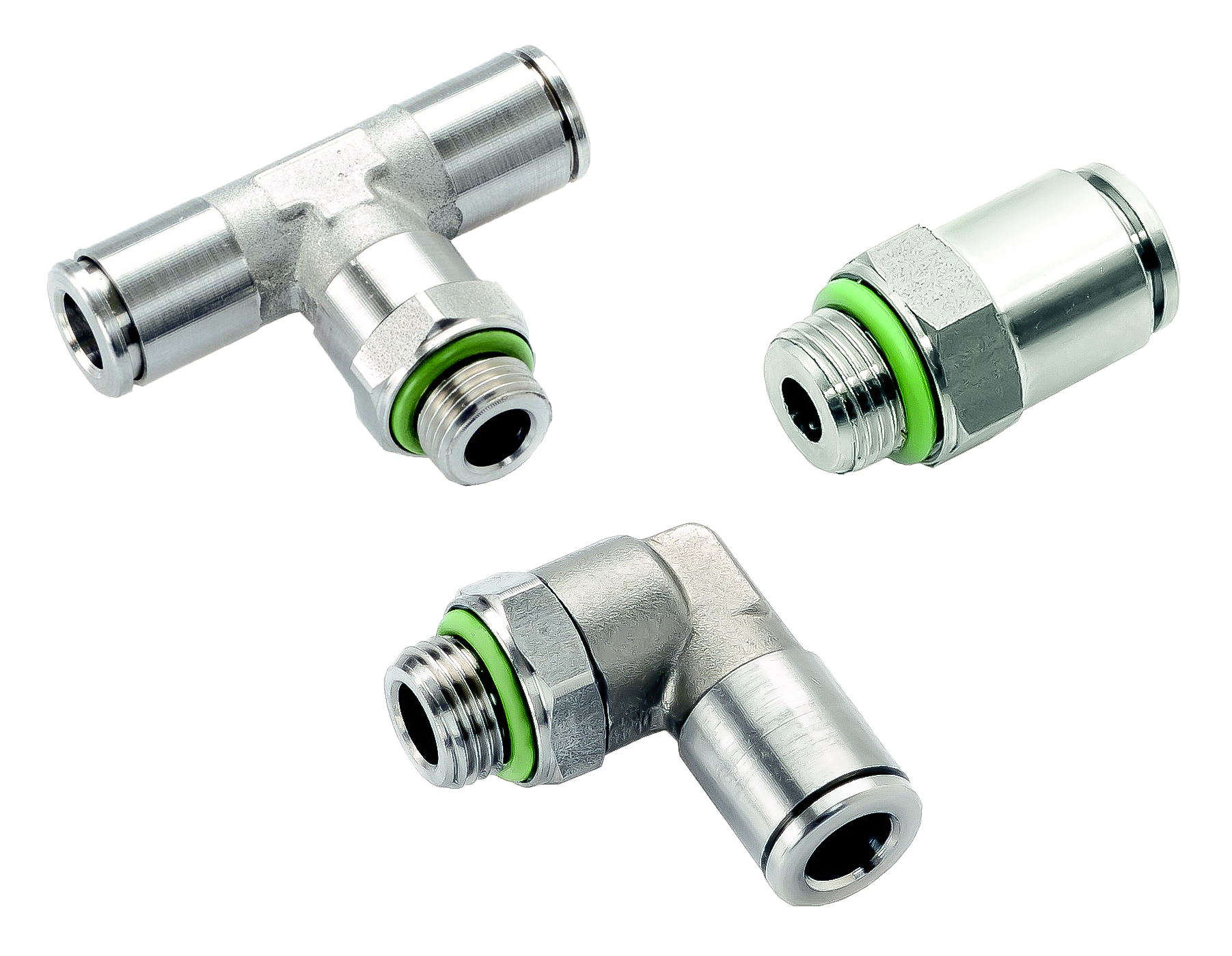
The PC Series is available in a wide range of configurations: straight fittings, 90° elbow fittings, T-fittings, Y-fittings, reducers, and versions with male or female threads.
This range allows users to manage every branching point or change in network direction without resorting to non-standard adapters, which increase the number of joints and, consequently, potential leak points.
During system design, the availability of elbow fittings makes it possible to reduce forced tube bending, which over time can cause deformation and weaken sealing performance.
T-fittings and Y-fittings enable inline branching without interrupting the main line, simplifying network layout design.
Installation time, maintenance and reliability of Push-In Fittings
In systems with a high number of connections — such as automated assembly lines or robotic cells — the cumulative pneumatic wiring time has a significant impact on total installation hours.
PC Series push-in fittings reduce this time by eliminating the tightening phase and removing the need for any specific tools.
From a maintenance perspective, replacing a damaged or worn tube does not require removing the fitting from its mounting position. The intervention is localized, reversible, and does not cause disruption to the remaining part of the circuit.
In environments with frequent changeover cycles — such as packaging machines or multi-format production lines — this translates into a direct reduction in machine downtime.
The lip seal, unaffected by variations in tightening force, maintains consistent performance throughout the fitting’s service life. In extensive networks, the absence of distributed leaks reduces compressed air consumption and stabilizes pressure at points of use.
Typical industrial applications
PC Series push-in fittings are used in all contexts where connection speed and ease of maintenance are important operational factors:
- Industrial automation and robotic cells, where pneumatic wiring is reconfigured according to the operating cycle or installed tooling.
- Automatic packaging and labeling machines, with a high density of connections in areas with limited accessibility.
- Multi-format assembly lines, where format changes require rapid reconfiguration of tubing sections.
- Distributed pneumatic systems with multiple branching points, where the modularity of available configurations simplifies layout design.
Product range variants for specific application requirements
For applications requiring construction features different from engineered polymer, the push-in fitting range includes additional solutions.
The A100 Series, featuring a fully metal body and collet (brass body with stainless steel collet), is recommended for systems exposed to impacts and continuous vibrations, such as machine tools or presses.
The A100X Series, manufactured from AISI 316L stainless steel, meets the chemical compatibility and industrial hygiene requirements demanded by the pharmaceutical, food processing, and chemical industries.
In both cases, the operating principle is identical to that of the PC Series: elastic collet with release ring, lip seal, and tool-free installation.
How to choose Push-In Fittings
The key parameters when selecting a push-in fitting are:
- Fitting body material: engineered polymer for standard applications requiring lightweight components; full-metal brass for environments subject to mechanical stress; AISI 316L for corrosive environments or applications with hygiene requirements.
- Tube diameter: the tube’s outer diameter must match the fitting size specification. Even minimal misalignment compromises collet performance.
- Configuration geometry: the choice between straight, elbow, T, or reducer fittings depends on system geometry and the need to minimize pressure losses in curved sections.
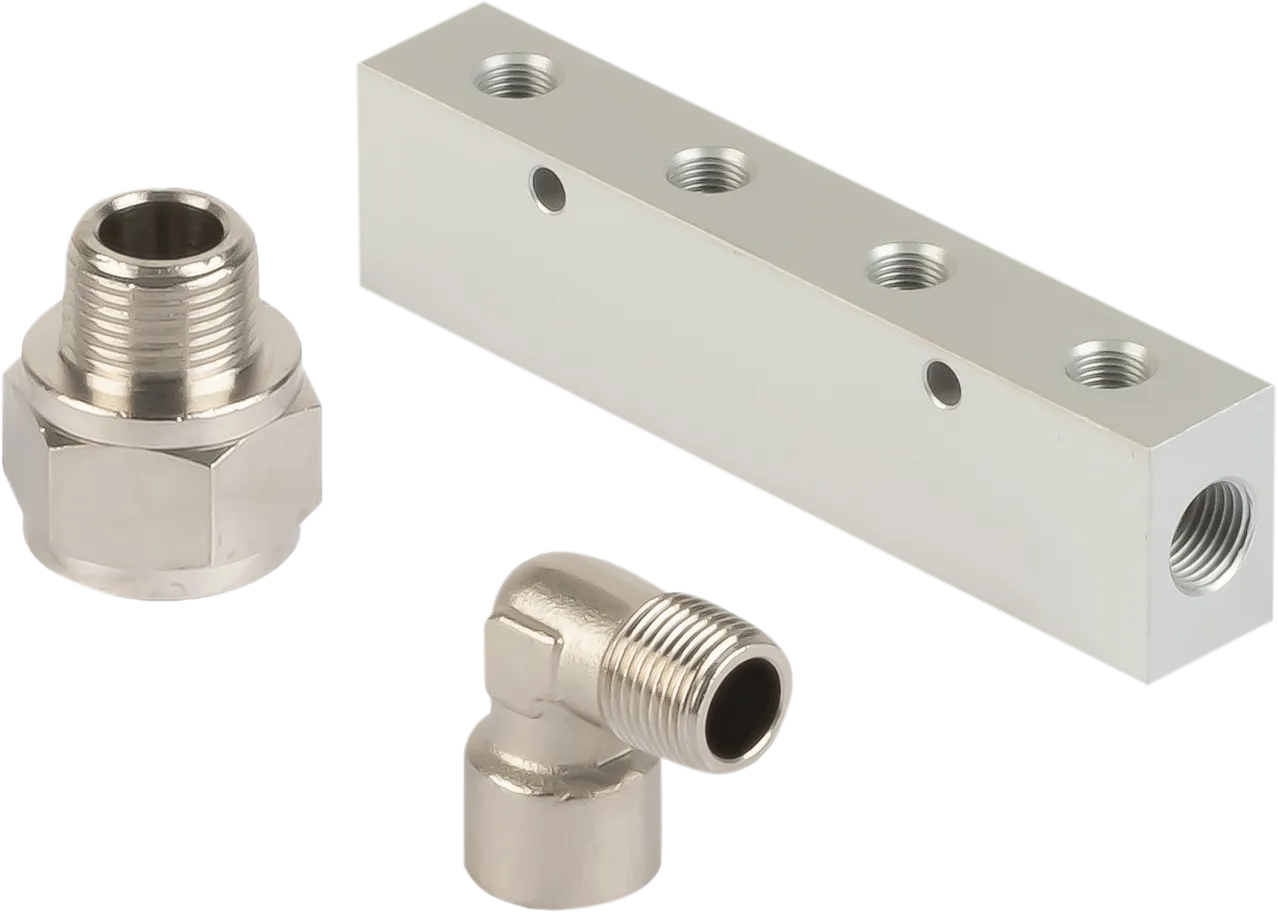
- Thread type: male or female, with dimensions matching the thread of the pneumatic component to which the fitting is connected.
- Maintenance frequency: in applications requiring frequent tube replacement, push-in fittings reduce intervention time and the risk of damaging the connection through incorrect tightening.
Impact on system performance
The PC Series push-in fittings from A&T Fluid Solutions combine a mechanically reliable locking principle with a design focused on operational simplicity.
The high-strength engineered polymer body with metal thread, the lip seal capable of compensating for minor tube cutting imperfections, and the compatibility with the main types of pneumatic tubing used in industrial automation make them a suitable solution for most industrial systems.
Where construction or environmental requirements demand it, the full-metal brass and AISI 316L variants extend the same connection concept to more demanding applications while maintaining the main advantage unchanged: a fast, secure, and repeatable tool-free connection.