

Rotary Cylinders RY Series
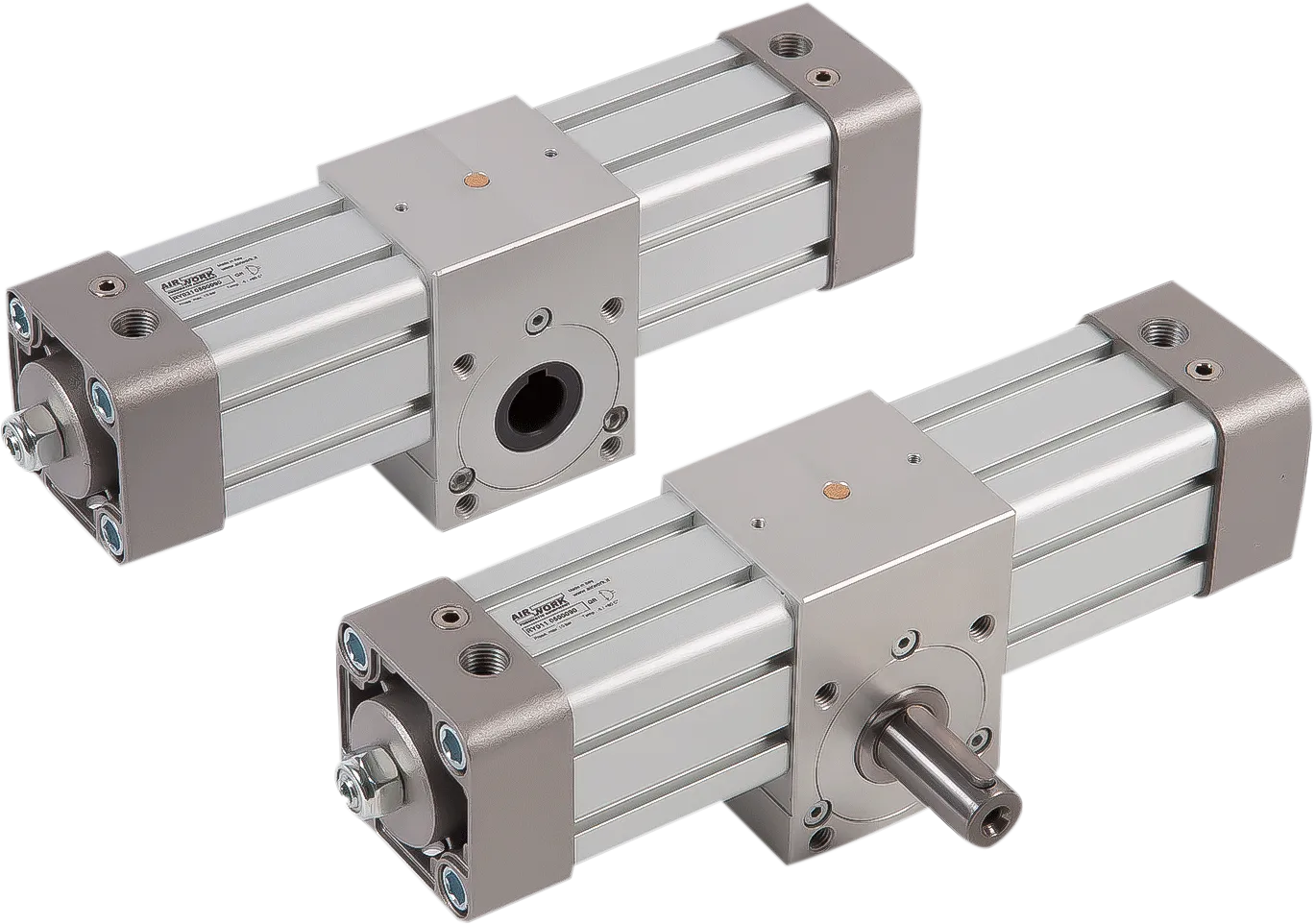
The RY Series rotary pneumatic cylinders are designed to transform the linear reciprocating motion typical of traditional pneumatic cylinders into a rotational motion with output torque via a rack-and-pinion system.
Thanks to their compactness, high mechanical strength, and operating precision, the RY Series is the ideal solution for handling applications, automatic orientation, part tilting, and driving tools or grippers in robotic cells and automated assembly lines.
Technical and Design Features
Precision and Backlash Compensation:
-
Angle Adjustment: Fine rotation angle adjustment system with a range of ±5°. This allows on-line compensation for assembly tolerances without stopping production.
-
Rack Guide: An adjustment mechanism using a guide rail (made of Delrin) minimizes backlash between the pinion and the rack, ensuring high repeatability performance.
Robust Construction and Integrated Cushioning:
-
Pneumatic Cushioning: Supplied as standard with adjustable pneumatic end-position cushioning to manage deceleration, reduce impacts, and extend component service life.
-
Pinion Treatment: The steel shaft/pinion undergoes a special surface heat treatment to ensure maximum resistance to cyclic loads and torsional forces.
Versatility and Configurations:
-
Bore Sizes Available: Ø 32, 40, 50, 63, 80, 100, 125 mm.
-
Standard Rotation Angles: 90°, 180°, 270°, 360° (custom rotation angles available upon request).
-
Pinion Versions:
-
Male Pinion (extended shaft with keyway).
-
Female Pinion (hollow shaft with keyway).
-
Further Information
Application context: handling and orientation in industrial pneumatic systems
In industrial automation systems, angular motion control is required in applications such as part orientation, tray tilting, tool positioning, and component sorting.
These processes require actuators capable of generating controlled torque with repeatable angular precision and dimensions compatible with robotic cells or compact stations.
The rotary pneumatic cylinder meets these requirements by converting the piston’s linear motion into rotation through an integrated rack-and-pinion system, without external mechanisms or transmissions.
The result is a compact actuator, directly integrable with grippers and tools, suitable for automatic handling and orientation applications.
Operating principle of Pneumatic Rotary Cylinders
The RY Series converts the linear motion of the pneumatic piston into rotary motion through a rack-and-pinion coupling.
Pneumatic supply in one chamber of the cylinder pushes the piston, whose rod is shaped as a rack; the rack teeth mesh with the pinion fitted on the output shaft, generating rotation. Motion reversal is achieved by supplying the opposite chamber.
This design makes it possible to precisely define the rotation angle according to the piston stroke and pinion module, making the device predictable and configurable already during the design phase.
The integrated pneumatic cushioning system manages the final deceleration, reducing end-of-stroke impacts and extending the life of the mechanical components.
Key design features
Rotation control
The RY Series integrates a rotation angle adjustment system with a range of ±5° from the nominal position.
This function is not merely decorative: in angular positioning systems, dimensional variations of machined parts or imperfectly centered tool mounting may require fine adjustments without modifying the mechanical structure.
The possibility of compensating for up to 10° total adjustment range directly on the actuator makes it possible to absorb these tolerances inline, without production downtime.
Positioning precision and backlash compensation
The rack-and-pinion system is subject to progressive wear of the intertooth contact, which appears as increasing angular backlash over time — a common issue in all actuators of this type.
The RY Series introduces an exclusive guide shoe adjustment mechanism that allows the backlash generated between the rack and pinion to be compensated even after a high number of operating cycles.
This means that angular repeatability can be maintained within nominal values throughout the actuator’s entire service life by acting on an adjustment register without disassembling the device.
Mechanical strength of the output shaft
The pinion undergoes a dedicated heat treatment to maximize surface mechanical strength.
This directly affects the permissible axial load and torque values applicable to the shaft: the possibility of directly connecting grippers, trays, or heavy tools without additional supports simplifies the mechanical design and reduces the number of components in the work cell.
Integrated cushioning
The pneumatic end-of-stroke cushioning system is included as standard. In high-speed applications, where rotation cycles occur at high frequency, the inertial management of the rotating load at the end of the stroke is critical to avoid rebounds and oscillations.
The integrated cushioning eliminates the need for external braking valves or additional damping devices, reducing the complexity of the pneumatic circuit.
System compactness
The rack-and-pinion architecture makes it possible to keep the actuator volume compact within dimensions comparable to an equivalent linear cylinder, with torque output directly on the shaft.
In robotic cells with limited space, or in multi-axis systems where the weight and dimensions of each actuator contribute to the overall balance, this feature is decisive.
Use of Rotary Cylinders and impact on system performance
The combination of fine angular adjustment, mechanical backlash compensation, and integrated cushioning produces three measurable effects at system level:
- Reduction of unplanned downtime: the possibility of compensating backlash inline, without disassembly, prevents progressive drift that in non-adjustable systems would require actuator replacement or recalibration with machine stoppage.
- Maintenance of production rate: the integrated cushioning allows fast cycles without post-stop oscillations, which in systems without damping would require waiting times before picking the part.
- Setup flexibility: the ±5° adjustment allows adaptation of the stop angle position to product variants or assembly deviations, without structural modifications to the system.
Technical analysis of the RY Series
Design solutions
The RY Series is manufactured by A&T and is available in the RY01, RY03, RY05, and RY07 variants, identifying progressively larger sizes differentiated by cylinder diameter, available torque, and permissible loads on the output shaft. The pinion undergoes a specific heat treatment to ensure surface hardness suitable for cyclic contact loads.
The rack adjustment system for backlash compensation is an exclusive design feature of the series, differentiating it from competing solutions lacking this function.
Available configurations
In addition to standard rotation angles, the RY Series is available on request in special rotation configurations for applications requiring non-standard angular ranges.
This makes it possible to cover specific application scenarios without resorting to fully custom solutions, while maintaining the construction advantages of the series.
Operational advantages
The main advantage compared to competing solutions without backlash adjustment is the long-term durability of precision: the user does not need to replace the actuator when angular repeatability exceeds the tolerated threshold, but can restore the original performance by acting on the adjustment register.
In environments with high production rates and continuous operation, this translates into a higher MTBF (Mean Time Between Functional Failures).
Industrial applications of Rotary Cylinders
Pick-and-place
In pick-and-place systems, the RY Series rotary cylinder is used to orient the gripper between the pick-up and component release positions.
The repeatability of the stop angle ensures the correct insertion of the part into its housing or onto the receiving conveyor, without depending on the tolerance of an external mechanical stop.
Part orientation
On assembly lines where the part must be presented with a specific orientation for the next operation (drilling, screwing, welding), the rotary cylinder performs the rotation in automatic cycle, synchronized with the line PLC through position sensors mounted on the actuator.
The fine ±5° adjustment makes it possible to compensate for positioning tolerances of the incoming part.
Compact automation
In automation cells with limited space — typically in consumer goods, electronics, and medical assembly — the compactness of the RY Series makes it possible to integrate a rotary axis where a traditional actuator with external transmission would not fit. This reduces the number of required stations and simplifies the handling logic.
Handling systems
The rotary cylinder is a frequent component in tray tilting systems, reject and non-conforming part sorting, and orientation reversal on reversible lines.
In these contexts, the available shaft torque and permissible axial load values determine the system’s ability to handle significant payloads without additional supports.
Selection criteria: when to choose a Rotary Cylinder
The RY Series rotary cylinder is the correct technical choice when:
- The required motion is discrete angular movement (from position A to position B) and not continuous rotation: for continuous rotation, a pneumatic motor is more suitable.
- Angular precision is critical over time: the backlash compensation function is decisive in high-cycle applications where angular drift would be unacceptable.
- Space is limited: the output shaft is directly integrated into the actuator, eliminating external transmission.
- The pneumatic circuit must remain simple: the integrated cushioning reduces the number of required control valves.
- Non-standard angles are required: the availability of special rotations on request avoids completely custom solutions.
It is not the correct choice when the movement requires multi-position control (more than two angular positions), where an electric actuator or cam system is more suitable.
The RY Series rotary pneumatic cylinders are designed for the control of angular motion in medium- and high-speed automation systems.
The distinctive value of the series lies not only in the rack-and-pinion conversion system, but also in the solutions that maintain constant performance over time: mechanical backlash compensation, fine adjustment of the stop angle, high-strength pinion, and integrated pneumatic cushioning.
For the designer, this means maintaining precision and angular repeatability throughout the entire operating life, while reducing auxiliary components and maintenance operations.
For production, this means greater line continuity and reduced machine downtime.
The RY01–RY07 range covers the main light and medium-duty handling applications, with availability of special angles for non-standard application requirements.