

Cylinders ISO 6432MC series
High performance, minimal footprint, and maximum reliability for industrial automation.
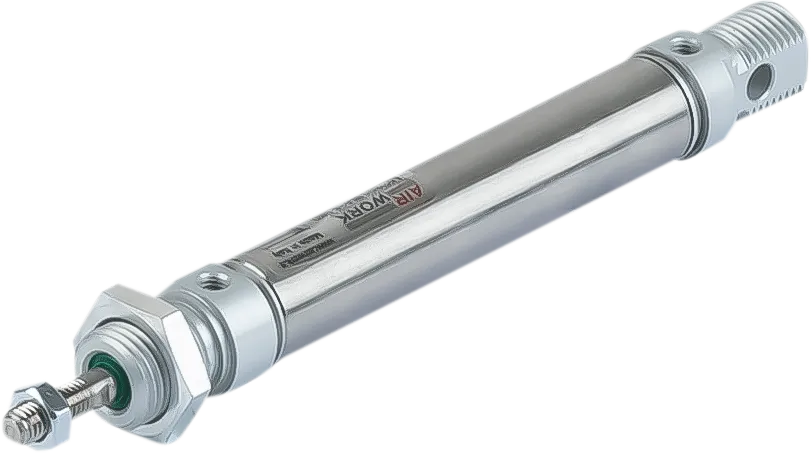
The ISO 6432 pneumatic micro-cylinders of the MC Series are designed by Airwork to guarantee maximum positioning accuracy and high resistance to heavy-duty cycles. Available with bores from 8 to 25 mm, they offer complete interchangeability and a wide range of configurations to meet the most demanding requirements of machine builders (OEMs) and maintenance engineers.
Key Construction Features:
-
Rolled AISI 303 stainless steel rod: Drastically reduces friction, ensures immediate response, and extends seal life.
-
Bronze guide bushing: Eliminates radial play when the rod is fully extended and ensures high mechanical stability.
-
Metal piston (brass): Unaffected by high-frequency operational stress (no deformation typical of plastic pistons).
-
High-efficiency seals: Standard polyurethane or optional Viton, High/Low Temperature, and Low Friction versions.
-
ATEX certification available: For safe operation in potentially explosive atmospheres.
Why choose the MC Series: Construction excellence and materials
In modern automation systems (packaging, electronics assembly, pharmaceuticals), dimensional compliance with the ISO 6432 standard alone is not enough. What determines operational continuity and prevents costly downtime are the internal design details:
-
Overcoming Stick-Slip: The rolled piston rod ensures a high-precision surface finish. It reduces breakaway friction and air consumption, ensuring smooth movement even after prolonged standstills.
-
Self-Lubricating Bronze Guide Bushing: Housed in the front end-cap, it absorbs side loads at the end of the stroke where the lever arm is most unfavorable, preventing leakage and asymmetric wear.
-
AISI 304 Stainless Steel Barrel and Rolled End-Caps: The mechanical crimping of the caps onto the stainless steel tube ensures a compact, monolithic structural hold.
Additional Information
What compact pneumatic systems require today
Modern automation architectures — electronic assembly lines, packaging machines, sorting and handling stations in the pharmaceutical sector — concentrate an increasing number of actuators in ever smaller spaces.
Under these conditions, the linear pneumatic cylinder must deliver adequate force with minimal dimensions, maintaining positioning repeatability compatible with process tolerances and a service life sufficient to sustain millions of cycles without maintenance.
The ISO 6432 standard, which defines interface dimensions for cylinders with bores from 8 to 25 mm, meets the need for interchangeability: it allows replacing an actuator without redesigning the assembly, standardizing stock and reducing downtime.
However, compliance with the standard alone does not distinguish one cylinder from another. Real performance is determined by the internal design choices.
Limits of conventional solutions
Traditional micro cylinders in this size range show recurring critical issues.
The first problem is static friction. Standard seals tend to increase breakaway resistance with wear, generating a stick-slip effect that degrades positioning accuracy.
In high-speed cycles, even a few tenths of a millimeter of variability can compromise the quality of the finished product.
The second concerns the rod radial play. Without a dedicated guide, the piston operates with excessive clearance, especially at end of stroke where lateral loads are highest. The result is asymmetric seal wear, progressive leakage and loss of force.
The third is piston strength. Plastic pistons, common in low-cost solutions, deform under repeated high-frequency cycles, losing concentricity and compromising sealing.
Design solutions that make the difference
The performance of the MC series is based on carefully selected design solutions and materials.
Each component is designed to improve efficiency, durability and long-term reliability:
- Rolled rod in AISI 303 stainless steel. Surface rolling is a mechanical process that closes surface porosity and induces residual compressive stress. The result is a low-friction finish that reduces cylinder breakaway pressure and extends seal life. In fast cycles, this translates into quicker response and lower air consumption.
- Bronze guide bushing. Housed in the front head, it acts as a sliding bearing for the rod and limits radial play at full extension, where the lever arm is most unfavorable. Thanks to its self-lubricating properties, bronze maintains consistent sliding performance over time without maintenance.
- Brass piston. Compared to plastic alternatives, brass withstands mechanical stresses of repetitive cycles without deformation. A piston that maintains its geometry also preserves seal integrity, ensuring consistent force throughout the cylinder’s service life.
- Polyurethane seals. On both rod and piston, polyurethane combines low wear, low friction and effective sealing even without lubrication. For special conditions, Viton seals (rod only), high-temperature (−10 °C to +150 °C), low-temperature (−40 °C to +80 °C) and low-friction options are available.
- AISI 304 stainless steel tube and aluminum end caps. The end caps are fixed to the tube by rolling, a process that ensures structural integrity while reducing axial length compared to threaded systems. The stainless steel tube provides corrosion resistance without additional surface treatments.
The MC series: technical data and configurations
The MC Airwork series by A&T Fluid Solutions applies these design principles in a range covering six bores (8, 10, 12, 16, 20 and 25 mm) and a wide variety of configurations.
Forces and pressure. Maximum operating pressure is 10 bar. At 6 bar, theoretical pushing forces range from 30 N (8 mm bore) to 295 N (25 mm bore), with pulling forces between 23 N and 247 N. The working fluid is compressed air, with or without lubrication. Standard operating temperature ranges from −20 °C to +80 °C, extendable with special seals.
Versions:
- Single-acting with front or rear spring (strokes from 10 to 50 mm, all bores).
- Standard double-acting with strokes up to 320 mm for 20 and 25 mm bores.
- Double-acting with pneumatic cushioning (16, 20, 25 mm bores) for controlled end-of-stroke stopping, allowing higher speeds while protecting internal components.
- Double-acting with through rod, with or without cushioning.
- Anti-rotation version with hexagonal rod.
- Version with integrated rod lock for position holding without pressure.
- Short series without rear thread for installations with longitudinal space constraints.
- Version with rear axial air supply.
Position sensing. All cylinders are available in a magnetic version with plastoferrite magnet on the piston, compatible with external T-slot sensors (Reed or Hall technology, M8 connector or 2.5 m cable).
ATEX version. Available with classification Ex II 2G Ex h IIc T5 Gb / Ex II 2D Ex h IIIc T100°C Db for potentially explosive atmospheres.
Accessories. Complete range of steel mounting accessories: female clevises, feet, flanges, rod ends, fork joints with clips, rod and head nuts. Guide units (type H and U) and external rod lock are also available. Custom designs on request.
Typical applications
In packaging, MC series cylinders operate cutting, sealing and diverting units with short strokes and high cycle rates. The cushioned version protects tooling and reduces vibrations transmitted to the machine structure.
In electronic assembly, 8 and 10 mm bores drive mechanical pick-and-place systems where space is limited and repeatability is critical.
In the food and pharmaceutical sectors, the stainless steel tube and rod construction and the ability to operate without lubrication allow use in areas in contact with sensitive products.
The fully stainless steel version (MX series) meets the most stringent hygiene requirements. The rod lock version maintains valves or diverters in position even in case of pressure loss, ensuring operational safety.
Selection criteria for designers
Selection should follow this logic:
- verify that the bore provides the required force under actual system pressure conditions, not just nominal values;
- evaluate whether the configuration — single or double acting, with or without cushioning, with or without rod lock — meets functional requirements without additional external components;
- consider construction materials as an indicator of total cost of ownership, where a rolled rod, bronze bushing and brass piston can make the difference between maintenance every six months or every three years;
- choose a product with sufficient mounting options and accessories to optimize layout case by case, without custom fittings or brackets.