

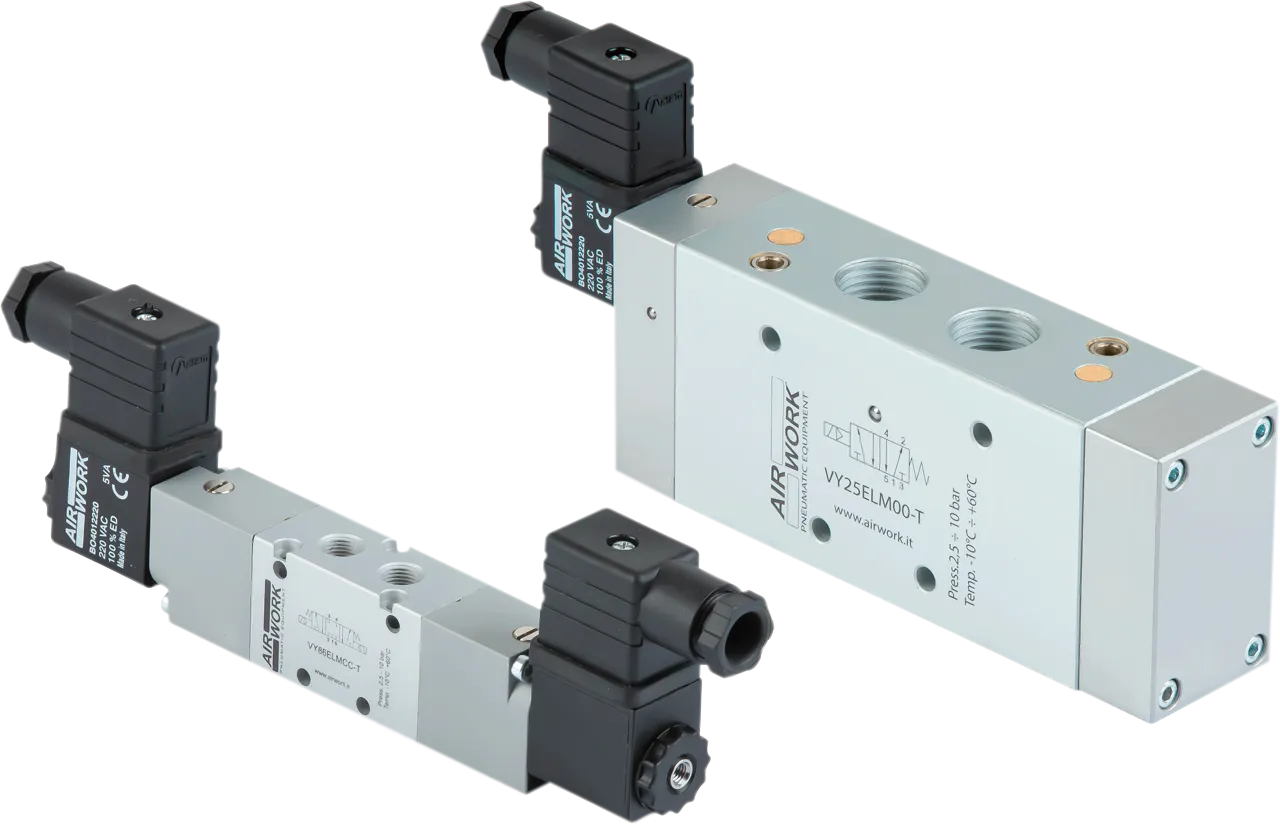
Solenoid ValvesVY Series
- Guaranteed to function for 50 million cycles
- CNC machined body, anodized and painted to ensure precision and durability over time
- Internal metal components to limit thermal expansion
- Availability in ATEX version
Airwork VY Series solenoid valves represent an excellent solution for pneumatic flow management, standing out in the market for their ideal balance of high robustness, operational reliability, and extraordinary application versatility.
The range adapts perfectly to the specifications of any system thanks to a complete and modular structure:
-
Three sizes: available with 1/8″, 1/4″, and 1/2″ ports to cover a wide spectrum of flow rates.
-
Main pneumatic functions: configurable in 3/2 (for operating single-acting cylinders or auxiliary signals), 5/2 (for double-acting cylinders), and 5/3 versions with closed, open, or pressurized centers, ensuring maximum safety even during emergency stops or intermediate positioning.
Thanks to the high quality of the materials used — such as the body machined from solid aluminum bar stock and the ultra-high-finish spool —, VY Series solenoid valves guarantee a service life of up to 50 million cycles, excellent tightness even under severe thermal fluctuations, and outstanding resistance in the most demanding industrial environments.
Additional information
What industrial pneumatic systems require today
Modern pneumatic architectures — assembly lines in the automotive sector, pick-and-place systems in packaging, dosing islands in pharmaceuticals — require machine cycles with actuation times in the order of a few tens of milliseconds.
Added to this is the push to reduce footprint and limit energy consumption: compressed air accounts for 20–30% of the electrical energy in a typical manufacturing plant, and every watt dissipated by a coil or every millisecond of switching delay translates into tangible operating costs.
In this context, selecting a solenoid valve can no longer be based only on nominal flow rate and port size. It must consider the component’s impact on dynamic performance, efficiency and reliability of the entire system.
Limits of traditional solutions
Conventional solenoid valves present three recurring bottlenecks in high-cycle applications.
The first is response time. A solenoid valve with activation above 30–40 ms introduces delays that, multiplied by the number of actuations per cycle, reduce line productivity. In high-speed sorting applications, a 20 ms delay can mean one missed item per cycle.
The second concerns construction materials. Spacers, cages and plastic guides are subject to thermal expansion: in environments between 10 °C and 50 °C — a common condition near actuators — deformations alter internal tolerances, causing leaks, slowdowns and, in the worst cases, mechanical jams.
The third is mounting rigidity. The modern solenoid valve no longer lives only in a centralized pneumatic panel: it must be installable on the actuator, in modular manifolds or on walls in confined spaces. Single-configuration solutions force additional fittings, custom brackets and increased footprint.
Design solutions that make the difference
The performance of a pneumatic valve does not depend only on nominal data, but on the design choices that determine its behavior and reliability over time
Some construction aspects directly affect system speed, durability and efficiency:
- Switching speed. Response times depend on the mass of moving parts, spring force, magnetic circuit efficiency and internal friction. In monostable versions, activation and release are asymmetric (release is slower because it is spring-driven); in bistable versions, both switching actions are electrically controlled with symmetric timing. The choice depends on the cycle: monostable valves ensure safe return in case of power loss, while bistable ones offer lower consumption.
- Metal construction of critical components. An aluminum spool treated with chemical nickel plating has very low surface roughness, reducing friction and seal wear. Brass spacer cages eliminate thermal deformation typical of plastic, maintaining consistent tolerances. These design details make the difference between a valve that reaches 10 million cycles and one that guarantees 50 million.
- Energy efficiency. A low coil consumption — around 2 W in DC — is not only direct savings: it means less heating, reduced seal degradation and the possibility to assemble high-density manifolds without thermal issues.
- Mounting versatility. The ability to install the valve in-line, on a wall, on a manifold, on a base plate or directly on the cylinder reduces valve-actuator distance, minimizes air volumes between components and improves system responsiveness.
The VY series: technical data and operational advantages
The VY series embodies these principles in a range covering three sizes (1/8″, 1/4″, 1/2″) and 3/2, 5/2 and 5/3 functions. Here’s what the data shows.
Response times. In size 1/8″ monostable: TRA 15 ms, TRR 35 ms. In bistable: 20 ms symmetric. For 1/4″: 19 ms / 45 ms (monostable), 22 ms symmetric (bistable). Values that place the series among fast-response solenoid valves, suitable for rates above 30 actuations per minute.
Flow rate. 550 Nl/min (1/8″), 1100 Nl/min (1/4″), 4600 Nl/min (1/2″) at 6 bar with ΔP 1 bar — generous flow sections relative to size, with nominal diameters of 5, 7.5 and 13 mm.
Construction. Body in aluminum machined from solid bar, CNC processed, anodized and painted. Aluminum spool with chemical nickel plating. Brass spacer cages. Manual override in nickel-plated steel. Spool and piston seals in NBR. No plastic components in critical functional areas. Result: 50 million cycles guaranteed.
Consumption. 2 W (DC), 3 VA (AC). Suitable for high-density manifolds.
Operating range. Pressure from 2.5 to 10 bar (monostable), from 1 to 10 bar (bistable), from vacuum to 10 bar with separate supply. Temperature from -10 °C to +60 °C.
ATEX version. Available with classification II 2G Ex h IIB T5 Gb / II 2D Ex h IIIB T100°C for potentially explosive atmospheres.
Typical applications
In automated assembly, direct mounting on the cylinder eliminates intermediate fittings and improves cycle repeatability.
In pharmaceutical and food packaging, fully metal construction and ATEX availability meet robustness and compliance requirements.
In wood and metal machining, brass cages and nickel-plated spool ensure stability even in the presence of vibrations and high temperatures.
Selection criteria for designers
Selection should follow this hierarchy:
- verify that response time is compatible with the machine cycle time budget;
- evaluate flow rate under real system pressure conditions, not only nominal values;
- choose a solution with flexible mounting options to optimize layout case by case;
- consider construction materials and declared lifetime in millions of cycles as an indicator of total cost of ownership.